



20 Oct Business Support Services in South Africa: The Proven Power of 1 Integrated Partner
Business support services in South Africa were meant to make life easier for SMEs — but for many founders, it’s become one of their biggest frustrations.
A 2023 SME Insights report found that over 68% of small and medium-sized enterprises (SMEs) in South Africa rely on four or more external providers to manage their business support services like accounting, payroll, compliance, and digital operations. Yet more than half of those surveyed said that miscommunication between those providers had led directly to missed deadlines, duplicated costs, or compliance penalties.
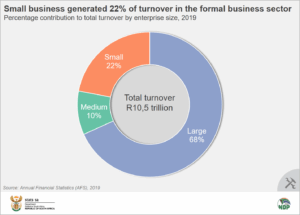
Source: Stats SA “Three facts about small business turnover in South Africa”
It’s a structural flaw baked into the way most companies grow. What begins as a smart decision – outsource what you can’t do in-house – often ends in a patchwork of disconnected services and conflicting advice.
And as regulation tightens, the stakes are getting higher. The South African Revenue Service (SARS) has increased late-submission penalties by 40% over the past two years, while the Companies and Intellectual Property Commission (CIPC) has ramped up compliance audits for SMEs. Businesses are discovering that their siloed support systems are leaving them vulnerable — not just operationally, but financially.
| Assessed Loss or Taxable Income (Preceding Year) | Fixed Amount Penalty (per month) |
|---|---|
| Assessed loss (negative) | R 250 |
| R 0 – R 250 000 | R 250 |
| R 250 001 – R 500 000 | R 500 |
| R 500 001 – R 1 000 000 | R 1 000 |
| R 1 000 001 – R 5 000 000 | R 2 000 |
| R 5 000 001 – R 10 000 000 | R 4 000 |
| R 10 000 001 – R 50 000 000 | R 8 000 |
| Above R 50 000 000 | R 16 000 |
Source: Tax Administration Act 2011 (Act No 28 of 2011), Section 211 – Fixed Amount Penalty Table. source.acts.co.za+1
The Outsourcing Trap
“Founders are tired of playing traffic cop,” says Melanie, co-founder of TYJ Innovations. “They’re managing five different service providers, none of whom are talking to each other. And when something goes wrong — a return is late, a document isn’t filed — no one takes responsibility.”
It’s a sentiment echoed across the sector. Fragmented business support systems often mean duplicated tasks, inconsistent data, and costly communication gaps. A payroll change might not reach the tax team. A compliance update might never inform the finance forecast. And every gap costs time — and money.
The result? Businesses spend more energy coordinating their service providers than building their actual business.
A Different Model: Integration Over Isolation
TYJ Innovations was built to offer fully integrated business support services — combining accounting, compliance, HR, digital strategy, and more under one roof. Rather than acting as separate providers, we function as a full-stack business infrastructure partner, giving SMEs one point of contact for everything they need to operate, scale, and stay compliant.
The model is simple but transformative: integrate every critical service – from company registration to compliance, finance, HR, strategy, digital, and beyond — into one cohesive support system.
“We don’t see ourselves as vendors,” explains co-founder Nadia. “We see ourselves as partners. Our clients don’t have to manage the gaps between services — we eliminate them entirely.”
This isn’t a bundled package of unrelated offerings. It’s an end-to-end ecosystem designed to ensure that every moving part of a business talks to every other part. A change in payroll immediately informs the tax team. Compliance decisions align with financial forecasting. Strategic decisions reflect real-time cash-flow visibility.
Partnership at the Core
Inside TYJ, that philosophy starts with the team itself. Every employee is treated as a partner, not a cog in a machine. That’s not just semantics — it’s the foundation of how the company operates.
“When you build a company where everyone thinks like an owner, you get very different outcomes,” says co-founder Lelani. “People stop focusing on tasks and start thinking about impact. They don’t just submit a return — they make sure that return supports the bigger financial strategy.”
That mindset extends directly to clients. TYJ doesn’t operate from the sidelines. It embeds itself in the day-to-day mechanics of a business, providing not just services but strategic oversight, practical support, and proactive guidance. This approach to business support turns a vendor into a true strategic partner.
Why It Matters More Than Ever
The SME landscape in South Africa is evolving fast and outdated business support services simply can’t keep up with regulatory and operational demands. Increased digitalisation, more aggressive regulatory enforcement, and a tougher funding environment mean that the days of “just getting by” with a few outsourced services are over. Businesses now need systems that think together, plan together, and move together.
That’s where TYJ believes the future lies: not in piecemeal outsourcing, but in holistic business partnerships that give founders back their time and their focus.
“Most entrepreneurs didn’t start their business to manage service providers,” Melanie adds. “They started it to solve a problem, to build something meaningful. Our job is to create the infrastructure that lets them do exactly that.”
The Future of Business Support
TYJ’s model is already resonating with companies that have outgrown the traditional outsourced approach. From early-stage startups needing everything from company registration to compliance, to established SMEs looking to modernise outdated systems, TYJ provides a single, accountable partner that connects the dots.
And as the market shifts, that holistic approach is becoming less of a competitive edge – and more of a necessity.
In a world where complexity kills growth, business support services that operate as one cohesive system are the future. And TYJ Innovations is betting that the companies who recognise that – and act on it – will be the ones still standing five, ten, and twenty years from now.